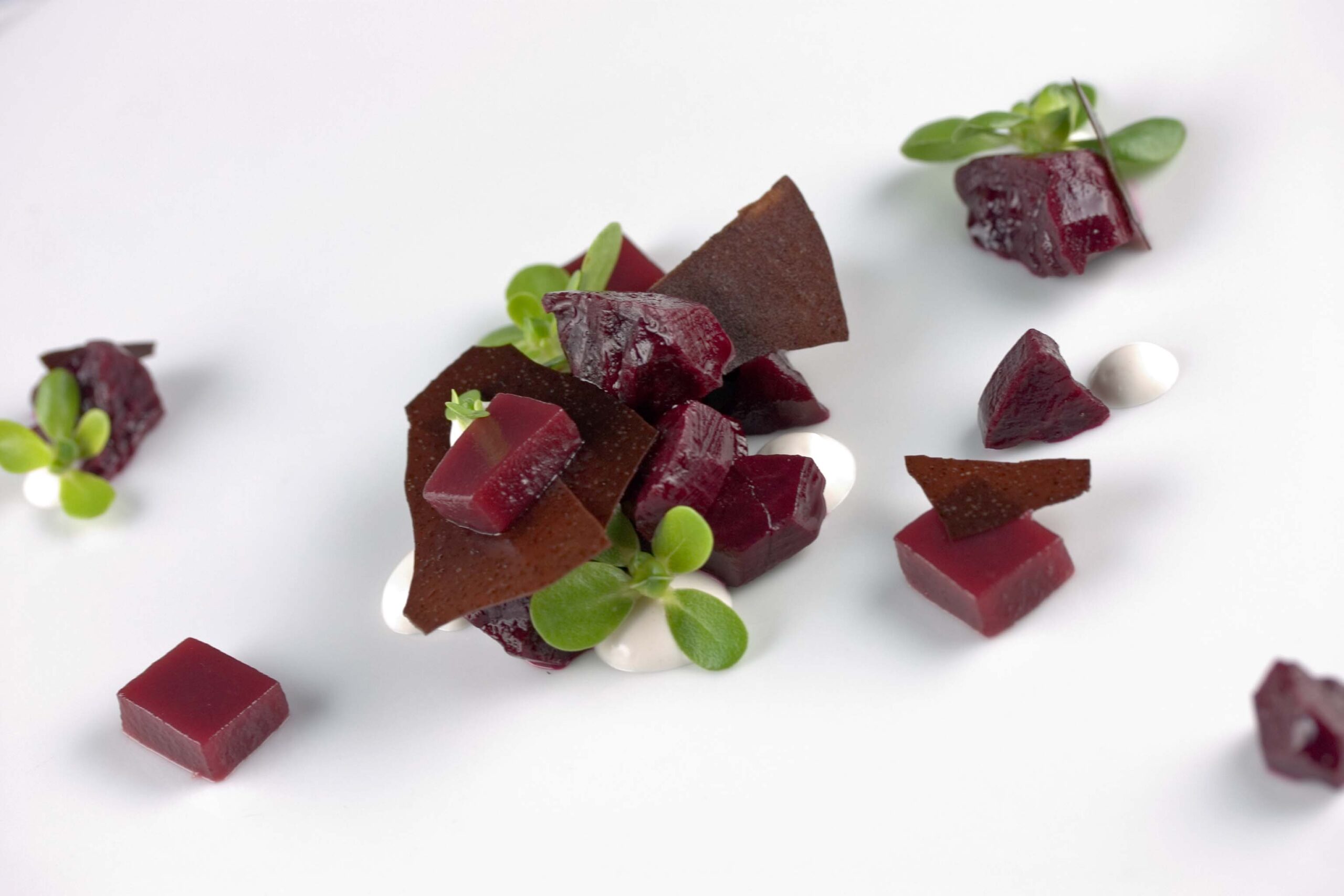
Broken Beet Salad
**Beet Marinade:**
– 115 grams pure cranberry juice
– 80 grams Vin Cotto
– 50 grams soy sauce
Blend the ingredients together and reserve.
**Broken Beets:**
– 450 grams peeled red beets
– 2 liters liquid nitrogen
– Beet marinade
Pour the liquid nitrogen into a Styrofoam cooler. Put the beets into the nitrogen and allow them to freeze solid. When the beets are frozen and beginning to crack apart from the extremely cold temperature, use a slotted spoon to remove them from the nitrogen into a large stainless steel bowl. While the beets are still rock solid, use a meat mallet to break and fragment the beets into chunks ranging in size from 1-3 cm. When the beets are broken, pour the marinade over the beets and place the entire container in the refrigerator to thaw out. The beets will thaw and slowly blend their own juices with the marinade. When the beets are completely thawed, put them and the marinade in a vacuum bag and seal on high pressure. Place the sealed beets in a water bath set at 83 degrees Celsius. Cook the beets for one and a half hours. When the beets are cooked, remove them from the water bath and place the sealed bag into an ice bath to cool the beets. Once the beets are ice cold, cut open the bag and pour the beets and the marinade into a shallow pan.
**Glazed Beets:**
– 250 grams beet cooking liquid
– 0.5 grams xanthan gum
Strain the beets through a fine mesh strainer. Reserve 250 grams of the beet liquid and discard any extra. Place the beet liquid in a blender and turn it on low. Increase the speed until a vortex forms in the blender. Sprinkle the xanthan gum into the vortex in order to evenly disperse it. Once the xanthan gum is dispersed, turn the blender off and pour the thickened beet liquid into a shallow pan, which will fit in a chamber vacuum sealer. To remove the air incorporated by blending the beet liquid, place it in a container so that it comes only one-third of the way up the sides. Place the container in the chamber of the vacuum machine and close the lid. The vacuum pulled on the chamber will begin to pull the air bubbles out of the beet liquid. The liquid will begin to climb the sides of the container and when it comes to just below the edge of the rim, shut the machine off. The chamber will then fill with air again and the beet liquid will shrink back down in the dish, having dispelled many of its air bubbles. This process should be repeated until the beet liquid loses 95% of its air bubbles and changes from pale purple to an intense concentrated purple-red. Pour the beet liquid back over the broken beets and stir to cover evenly. The thickening of the liquid allows the pieces of beet to be uniformly covered in their own flavorful juices. Reserve the dressed beets in the refrigerator.
**Black Olive Crisp:**
– 300 grams oil-cured olives
Place the olives in a pot and cover them with cold water. Bring the olives and water to a simmer and turn off the heat. Pour the water off of the olives, and then pat the olives dry on a paper towel. This process will remove the excess oil coating the olives, as well as some bitterness and salinity.
– 285 grams blanched olives
– 205 grams cranberry juice
– 110 grams glucose
– 90 grams isomalt
– Pan spray
– 8 pieces of acetate 5 cm wide and 15 cm long
Place the ingredients into a pot and bring to a simmer. Cook the mixture until the liquid reduces to a thick syrup and glazes the olives. Turn the heat off and pour the hot olives and the residual syrup into a blender. Turn the blender on low and increase the speed. Puree the olives until they are completely smooth. During this process, use a rubber spatula to scrape the olive puree down the sides of the blender so that everything is equally pureed. Once the olive puree is smooth, scrape it out of the blender top and into a fine mesh strainer. Press the olive puree through the strainer to remove any coarse pieces of olive. Place the olive puree into a container and reserve in the refrigerator until cold. Spray the acetate sheets with pan release and then use a paper towel to wipe off the excess spray, leaving a fine film. Lay the sheets on a flat counter and then use an offset spatula to spread a fine layer of the olive puree on the sheet. The layer should be just under a millimeter in thickness. Once all the sheets are evenly coated, place them in a dehydrator on medium and let dry until the surface is completely dry to the touch. When the top of the crisp is dry, peel the acetate from the back of the olive sheet and place the crisps back in the dehydrator to dry completely. The olive crisps will be flat, dry, and delicate when they are done. Remove them from the dehydrator and let cool on a countertop for a minute. Then place them in a container with several silica gel packs to prevent the crisps from getting soggy. Reserve the crisps.
**Cashew Yogurt:**
– 225 grams raw cashews
– 400 grams filtered or spring water
– 375 grams swollen cashews
– 200 grams spring or filtered water
– 25 grams of agave nectar
– 2 grams salt
– Cheesecloth
In a bowl, cover the raw cashews with the water. Cover the bowl with plastic and place it in the refrigerator overnight. The following day, strain the water off of the cashews and rinse the nuts. The swollen cashews should now weigh substantially more, having absorbed the water. Place 375 grams of swollen cashews in the blender. Add the water, salt, and agave nectar. Turn the blender on low and slowly increase the speed. Puree the mixture until it is smooth and homogenous. Turn the blender off and pass the mixture through a fine mesh strainer. Line another strainer with two layers of dampened cheesecloth and place the cashew puree in cheesecloth. Place the strainer in a bowl so that the cashew mixture in the cheesecloth is suspended and any extra moisture will drain out of the puree. Lightly cover the strainer with plastic wrap and place the cashews into the refrigerator to drain overnight. The following day, remove the thickened cashew yogurt from the cheesecloth and place it in a squeeze bottle. Discard any drained liquid.
**Cranberry Jelly:**
– 150 grams dried cranberries
– 130 grams dark rum
– 30 grams dark muscovado sugar
– 2 grams salt
– 245 grams cranberry base
– 150 grams cranberry juice
– 150 grams water
– 1.1 grams high acyl gellan
– 1.1 grams low acyl gellan
Put the dried cranberries, dark rum, muscovado sugar, and salt in a pot and bring to a simmer. Tilt the pot to flame the rum and turn off the heat. When the flame subsides, place the mixture in a blender and puree until smooth. Strain the mixture through a fine mesh strainer, pressing on the solids with a ladle to extract as much cranberry as possible. Weigh the cranberry base. It should weigh 245 grams. If there is extra base, subtract that amount from the water required in the recipe, and if the weight is less than 245 grams, add extra cranberry juice to supplement the missing cranberry puree. Combine the cranberry base, cranberry juice, and water in a blender. Turn the blender on low and increase the speed until a vortex forms. Sprinkle both types of gellan into the vortex and let blend for five seconds. Turn off the blender and pour the cranberry mixture into a pot. Cook the cranberry mixture, stirring constantly, until it reaches 90 degrees Celsius. When the mixture reaches 90 degrees Celsius, the gellan will be properly hydrated and the mixture may be poured into a 20 cm by 20 cm square Pyrex pan. Pour the mixture from pot to pan quickly and smoothly because the presence of the gellan in the mixture causes the cranberry jelly to set very quickly. Place the pan in the refrigerator to cool. When the jelly is cold, remove it from the pan and cut it into 32 rectangles 2 cm long and 1.5 cm wide. Reserve these jellies on a tray in the refrigerator. There will be more cranberry jelly than is needed for this dish and extra may be reserved for another use.
**To Assemble:**
– Glazed Broken Beets
– Cashew Yogurt
– Cranberry Jellies
– Olive Crisps
– 40 small purslane sprigs
Place a spoonful of glazed broken beets, 5-7 pieces depending on their size, in the center of a plate. Squeeze five dollops of cashew yogurt at 2, 4, 6, 10, and 12 o’clock positions in the crevices between the beets. Arrange purslane sprigs on the 10 and 4 o’clock dollops of cashew yogurt. Place one broken beet at the 12 o’clock position 6 cm away from the center. Squeeze a dollop of cashew yogurt on the far side of the beet, place a purslane sprig on top of the yogurt and lean a fragment of olive crisp on the right-hand side of the beet piece. Place a second broken beet piece at the 2 o’clock position 3 cm away from the central pile of beets. Squeeze a dollop of cashew yogurt to the outside of the broken beet. Place a third broken beet at the 3 o’clock position 8 cm from the center pile of beets. Place a fourth broken beet at the 8 o’clock position 5 cm away from the central pile of beets. Squeeze a dollop of cashew yogurt on the lower side of the beet and top with a sprig of purslane. Place a cranberry jelly at the 6 o’clock position 4 cm away from the center pile of beets. Place a second cranberry jelly at the 3 o’clock position 2 cm away from the center pile of beets and top with a piece of olive crisp. Place a third cranberry jelly at the 10 o’clock position, touching the center pile of beets and just above the cashew yogurt in the 10 o’clock position. Place a medium-sized olive crisp at the 12 o’clock position nestled into the pile of broken beets. Take a large piece of olive crisp, irregularly shaped though roughly 8 cm long and 4 cm wide, and top it with a cranberry jelly. Squeeze a small drop of cashew yogurt to the left of the jelly and top the yogurt with a sprig of purslane. Place this crisp on top of the pile of broken beets. Repeat with the other plates.
About the Author
